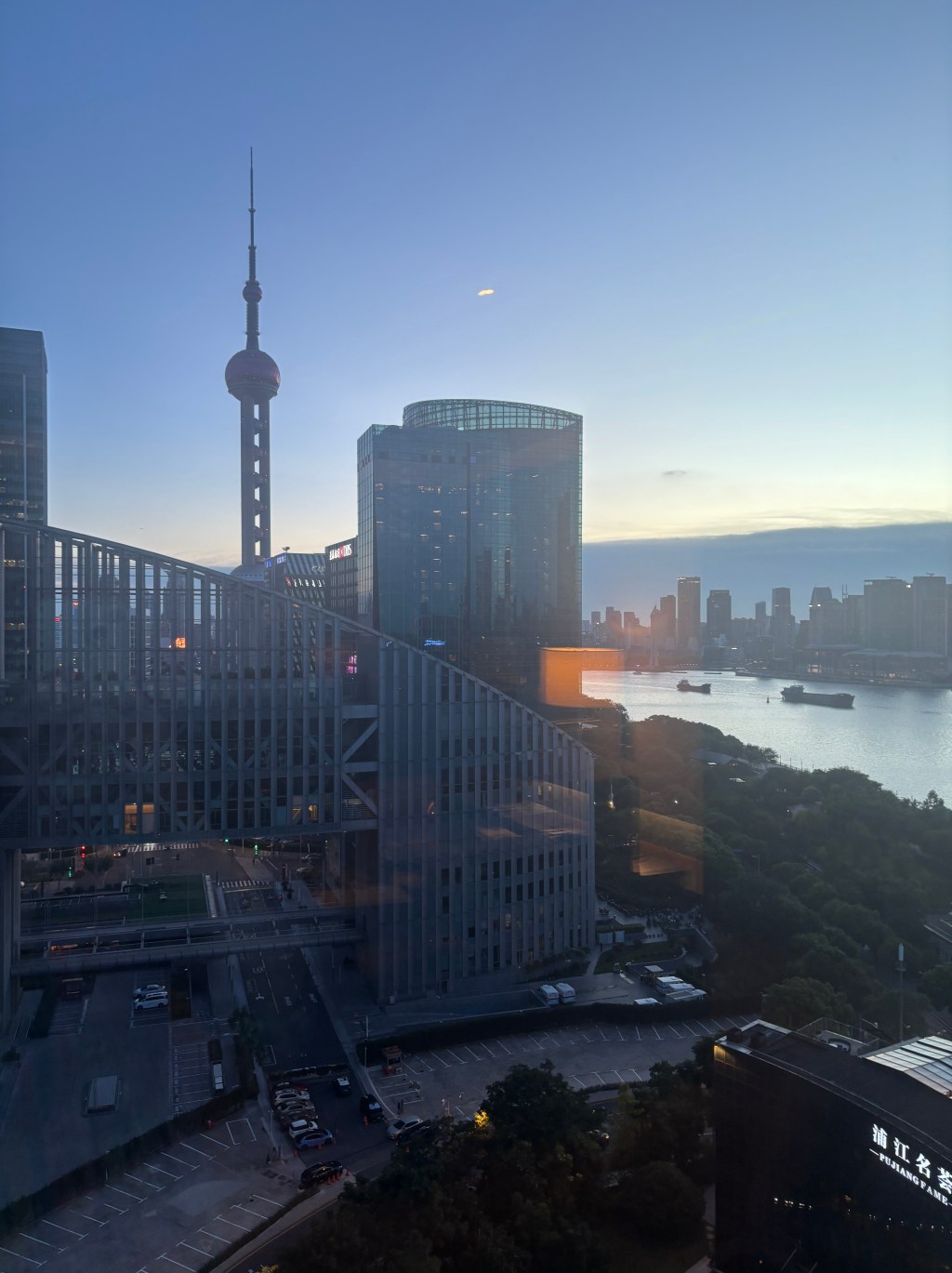
Good evening ladies and gentleman and a warm welcome from Shanghai, where I arrived safely after a very pleasant train journey at noon. I am currently sitting in my hotel room on the 19th floor with the view in the image of the header. Shanghai feels, as first impression, a lot more like being in the West again, even though it is clearly China, than Beijing. Whereas Beijing seems to be the cultural and political capital, Shanghai more seems to be the economic center. Besides that I was able to communicate again – what a satisfying moment. In my hotel I was facing a payment issue, due to a lacking verification in Ali Pay, and was able to communicate with the lady at the reception fluently and could figure out this more complex problem in English (okay, actually she was from Thailand, to stick with truth, but anyways).
What I have observed in all Asian cities until now, and currently it seems like Shanghai is facing a heat wave (it had 36 degrees today), is that everyone is avoiding sun as much as possible, tries to cover up, usage of umbrellas is widespread and the shadow places are the most popular ones. Regarding the risk of sun, and taking my skin type „British“ into consideration, I do think that is a very smart approach. Besides that, also all three cities I have been to do not feel as stressful as European ones as I do have the impression that people are in general less aggressive and you do no get bumped. Do you agree with these observations? What do you think?
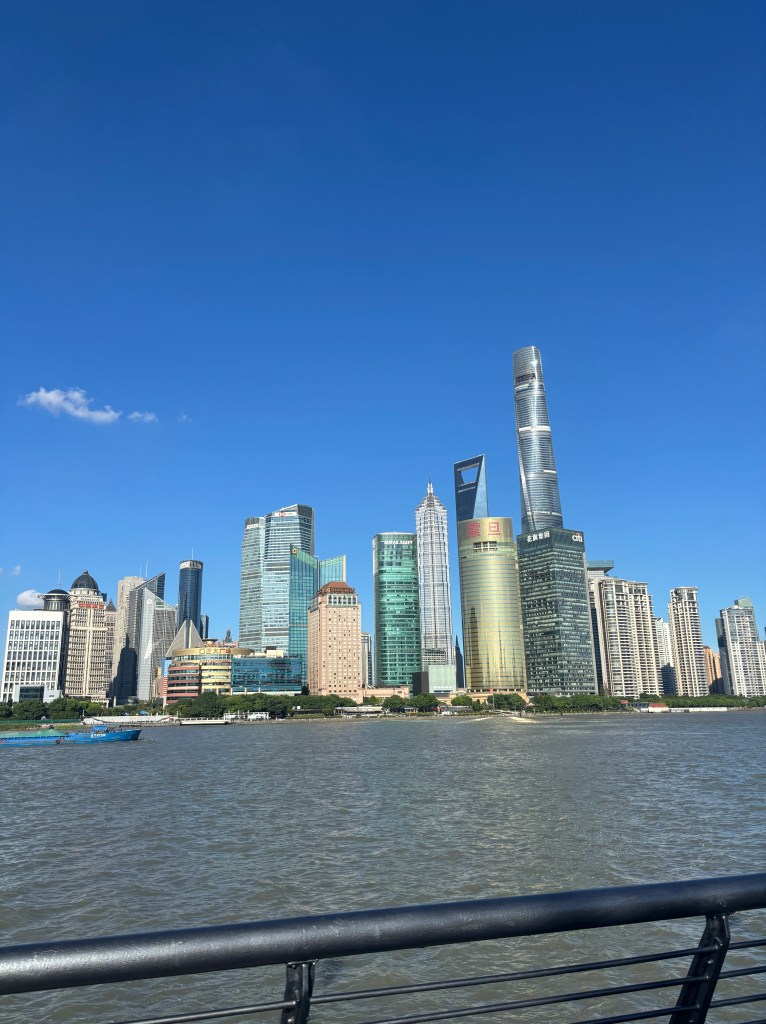
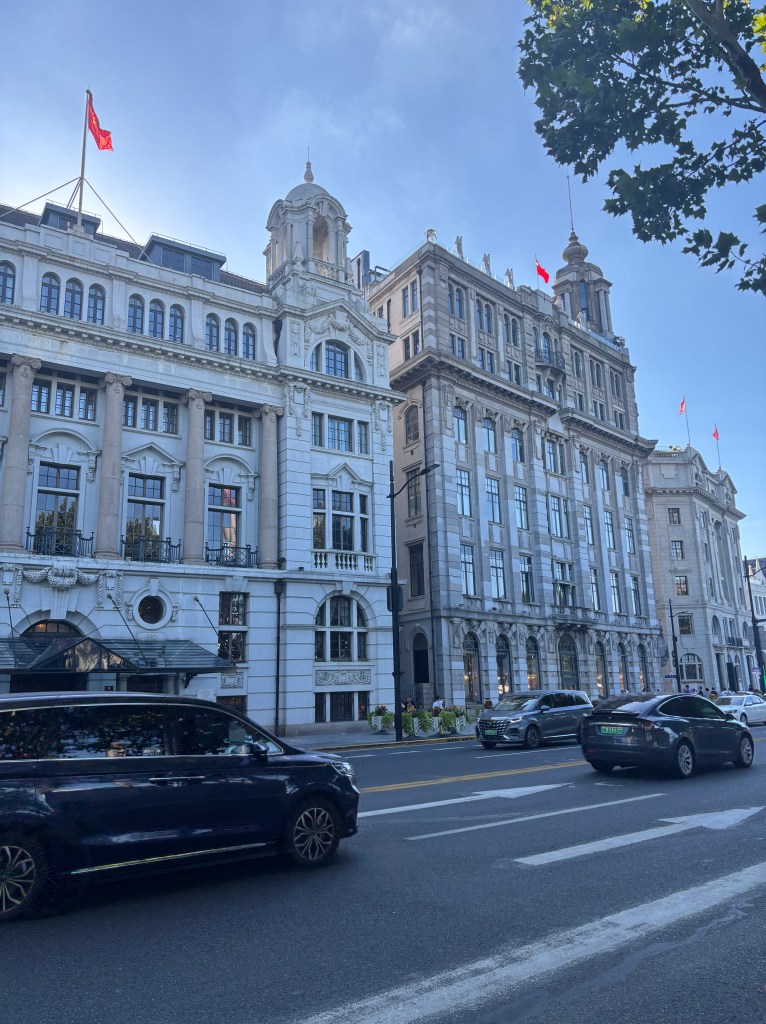
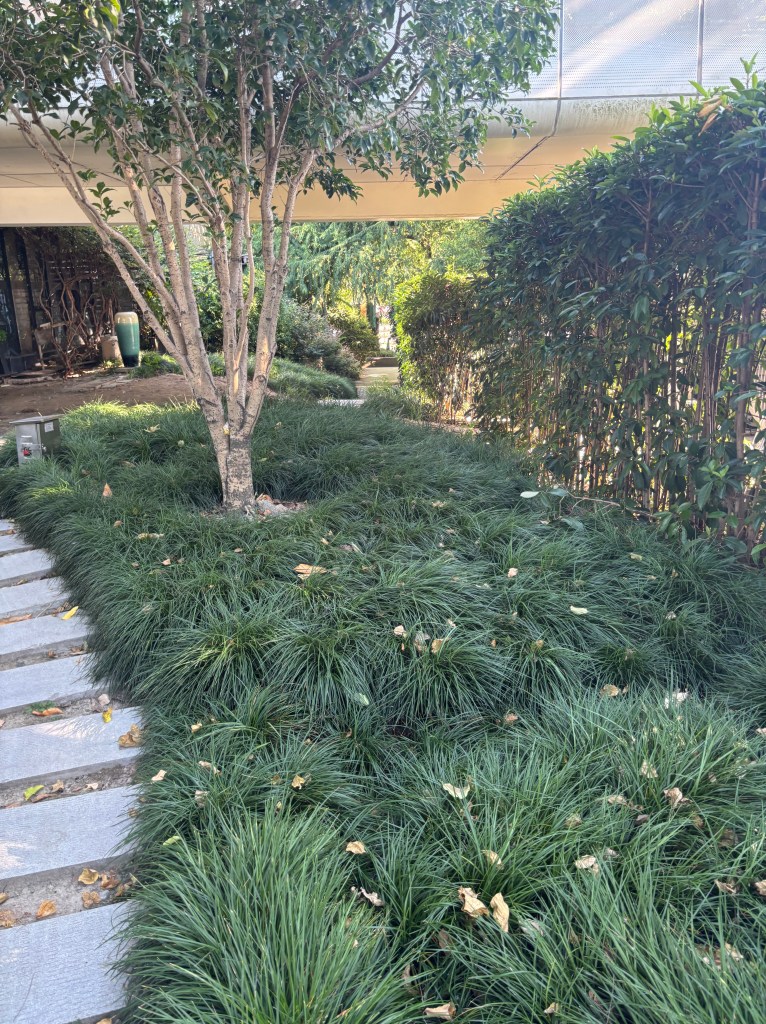
Some first impressions of Shanghai:
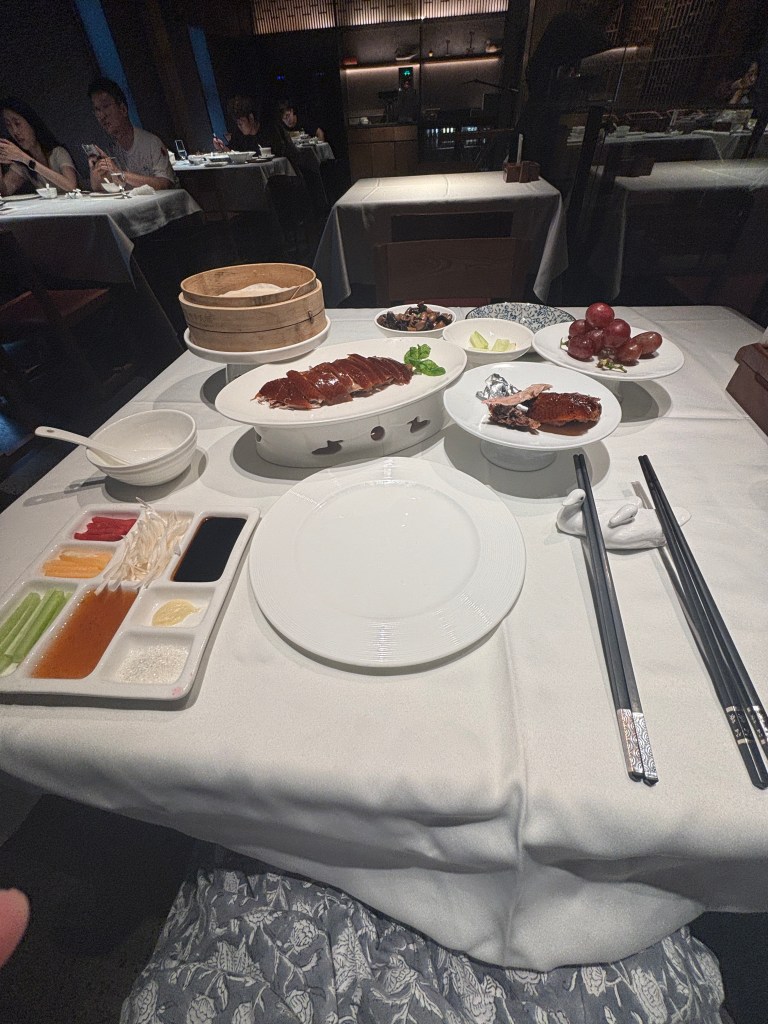
Besides my first dip into Shanghai I am still owing you an update on how my farewell from Beijing went. Frankly speaking yesterday I was exhausted from all the impressions and the permanent strangeness. So I decided, as I was aware that I will head to Shanghai today, to keep it calm. There was only one point on my list left that I definitely wanted to give a try before leaving Beijing: the famous Beijing duck. Thanks to my locals I had a recommendation on where to go and so I headed there for my lunch.
Due to the kind explanation of the waiter I have learnt the following: the skin is eaten with sugar. The thigh of the duck is eaten with a garlic sauce. For the pancake there are two different varieties: the traditional and the modern one. The modern one is with cucumber, and the orange vegetable as well as the orange sauce (on the plate in the left corner of the picture). The traditional way to eat the Beijing duck pancake is with the other two vegetables (with the red one is turmeric) and the dark sauce. I clearly preferred the modern interpretation and have to state it was probably the best duck I ever had. Overall the taste was great and really liked the restaurant but it wouldn’t be China without a pinch of confusion: multiple components of the meal (like the soup) or some of the pickles I haven’t ordered. Why have I received them? How do Chinese restaurants work?
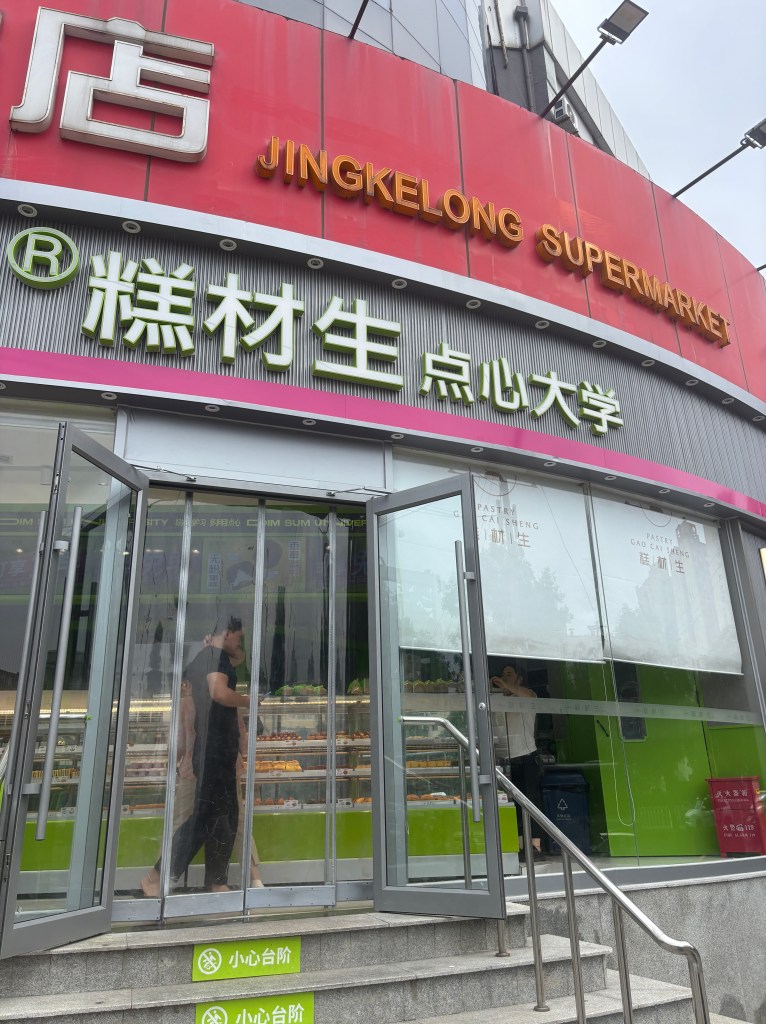
Next I needed to head to another recommendation of my travel support from London: Gao Cai Sheng. This seems to be like a pretty popular bakery chain, at least you see the bags quite offen. Unfortunately I couldn’t find the recommended brown, small chocolate balls and went for a mooncake (that was okay, but not over the moon) instead.
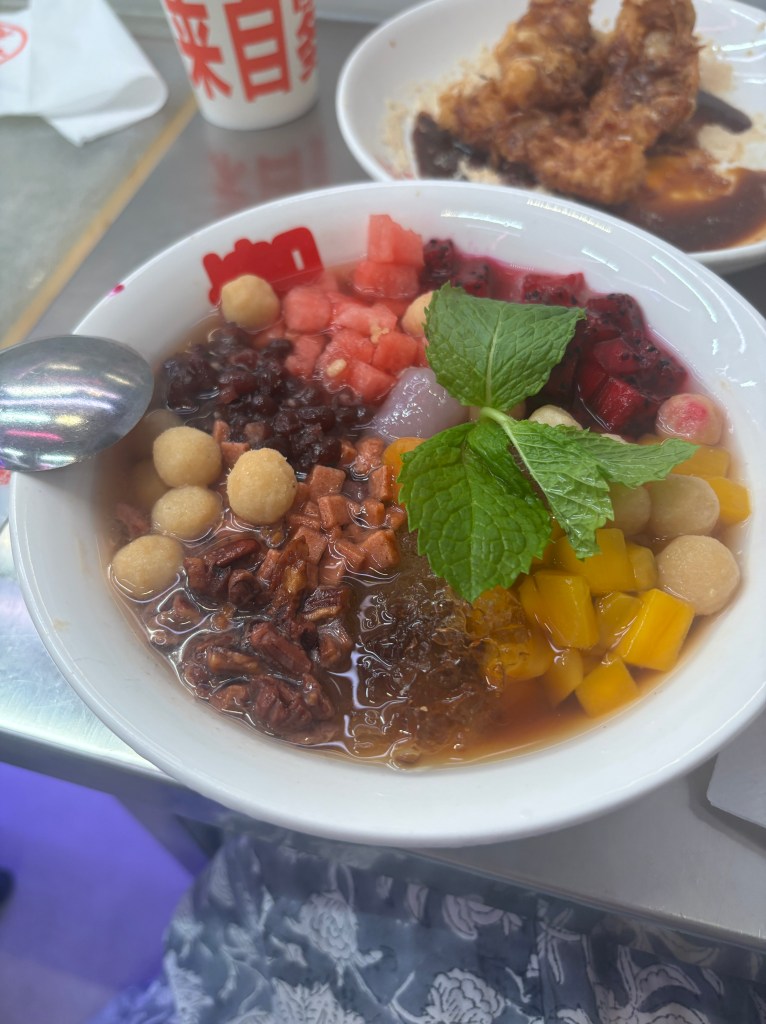
My last evening I wanted to spent at my happy place in Beijing: Sanlitun, to eat one last time the best dessert ever. As it was Friday evening yesterday and also working population, to which I normally proudly belong, was horsing around I had to wait a bit longer for my DiDi than usual (which by the way always works perfectly smooth). So I did had the opportunity to make some observations before my hotel:
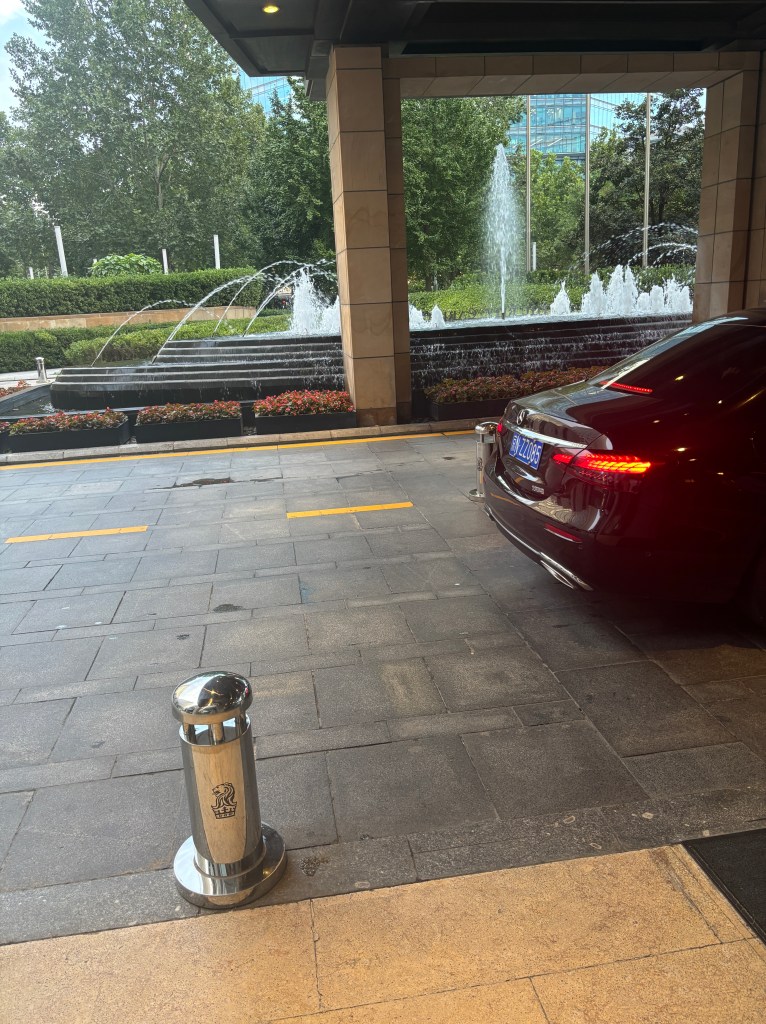
At my hotel only were arriving Chinese guests that Friday evening. All of them were wearing the top luxurious brands (Chanel, Dior, Prada you know the deal) and a Chanel bag really felt like state of the art. Me in my Longchamp bag and my cute dress from a small label from Munich almost felt like someone from a second world country (I am aware that this classification is politically not correct anymore but freedom of speech or like this). There was one black, posh Mercedes limousine after another arriving and I was once more impressed by the wealth that is now accumulated in China. Of course I am clearly aware that this only a very small and narrow snapshot that is not representative and very biased. As this is also some kind of, even though it was already 5 years ago (Covid and non stop at entry level jobs lead to the delay), my own present to me for my uni graduation with distinction, I have chosen hotels I would normally, as Swabian at heart, not choose.
So lets leave the anecdotes aside and dive into the numbers instead. I do not want to bore you so if you are not interested in Chinese macroeconomics just skip. According to the Stanford Center on China‘s Economy and Institutions (I am so glad I do not to comply to quotation standards anymore; graduation has its peaks) since 1978 China has transformed from a poor, relatively equal society into a leading global economy with levels of inequality surpassing much of Europe and resembling the US. The share of China‘s national income earned by the top 10% of the population has increased from 27% in 1978 to 41% in 2015. At the same time the wealth share of the top 10% of the population reached 67%, close to the US with 72%. Meanwhile, income for China‘s bottom 50% (539 million adults!) increased fivefold since 1978. China‘s share of world GDP increased from less than 3% in 1978 to 20% in 2015, while average income has increased by a factor of eight (!). Wealth, however, is significantly more concentrated than income: the top 10% holds approximately 67% of China‘s wealth compared to 41% for income. The top .001% owns 5.8% of China‘s total wealth, which is roughly equivalent to that of the bottom 50%. This might explain, while having a population of 1.4 billion people why China is such an important market for luxurious brands. It is actually the second largest in the world, that pretty obviously is accumulated in the places I am staying currently. According to Statista, and this trend should be alarming for classic luxurious brands, the younger generation, which is about to become the key target group within the next years, is more flexible with brand preferences and has a decreasing loyalty towards certain brands.
All the above mentioned analyses leaves me to the initial question: will Europe become the museum of the world? A place where you can visit Paris and eat gelato in Rome but economically insignificant that will become a playground for the (super) rich Asians and a real life Disneyland? It of course depends on the ability of the societies to adapt towards a fast-paced global economic. In an aging society, and also various Asian countries will face this obstacles, this will become increasingly difficult. What I see and feel especially in China (I haven’t been long enough in Singapore for detailed assessment) is that the society seems to be very dynamic and the country is literally under construction. Something that I am clearly missing in our over bureaucratic and static European societies (of course you have differences between countries, e,g. for construction regulation). Europe also has the clear disadvantage of being linguistically and culturally divided. Probably we could learn from Singapore how to truly become a European multiethnic society and will change the official language in one generation to English. I am clearly just dreaming.
A farewell dinner and one last evening stroll in Sanlitun I already was about to leave Beijing:



Beijing wasn’t a whirlwind romance like Singapore and even though I am very adaptable to wherever I am staying the language barrier to me sometimes was challenging (my own fault; should probably have studied harder). Beijing you are culturally rich, you breath history and at the same you feel like living in the future and radiate a dynamism Europe clearly lacks – as the capital you are a reflection of the contradictory of the proud cultural nation of China itself. To compensate my lack of previous communication at the hotel I left a farewell message to the employees in in Mandarin (I really hope it doesn’t mean chicken sweet and sour):
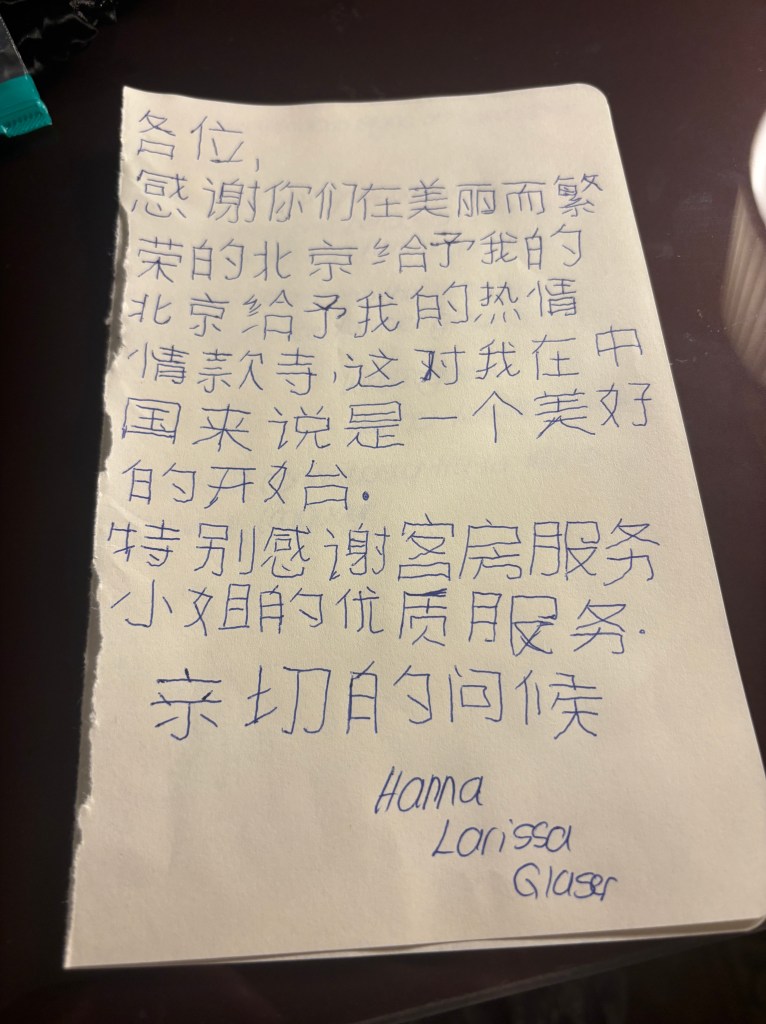
Thanks Beijing and now I am looking forward to my time in Shanghai!


Leave a Reply